Ask five agencies for a quote on digital marketing cost in India and you’ll get five wildly different numbers back. Not slightly different — sometimes triple. One shop in Delhi tells you ₹20,000 covers everything. Another one, two lanes over, wants three times that for what sounds like the exact same scope. It’s maddening if you’re just trying to plan a budget, and honestly, most business owners we talk to at Digital Socialite have already been burned once before they come to us.
This guide is our attempt to actually clear the fog. We’ll go through real digital marketing pricing India ranges for SEO, Google Ads, social media, and website development — plus all the sneaky extras that show up on invoices later — walk into the Digital Socialite for fair details and pricing.
Why Digital Marketing Costs Vary in India
There’s no rate card for this industry. Never has been. What you pay depends on your city, how brutal your niche’s competition is, the actual scope of work, and — this one catches people off guard — whether the agency knows what it’s doing at all.
Take a dermatology clinic in Chandigarh trying to rank for “skin clinic near me.” Completely different battlefield than a D2C brand trying to rank nationally for “buy running shoes online.” The clinic needs a tight local SEO push. The shoe brand needs writers, technical SEO people, and someone building links for months on end. So naturally, the SEO cost in India for these two businesses isn’t even close.
Team size plays into it too. Freelancers keep prices down because there’s no office rent, no ten-person account team eating into margins. Agencies like Digital Socialite cost more, but you get backup — if your point of contact disappears for two weeks, someone else picks up the account. So this is a much better option for your business.
Average Digital Marketing Cost in India (Quick Overview)
Here are the numbers most people actually came here for.
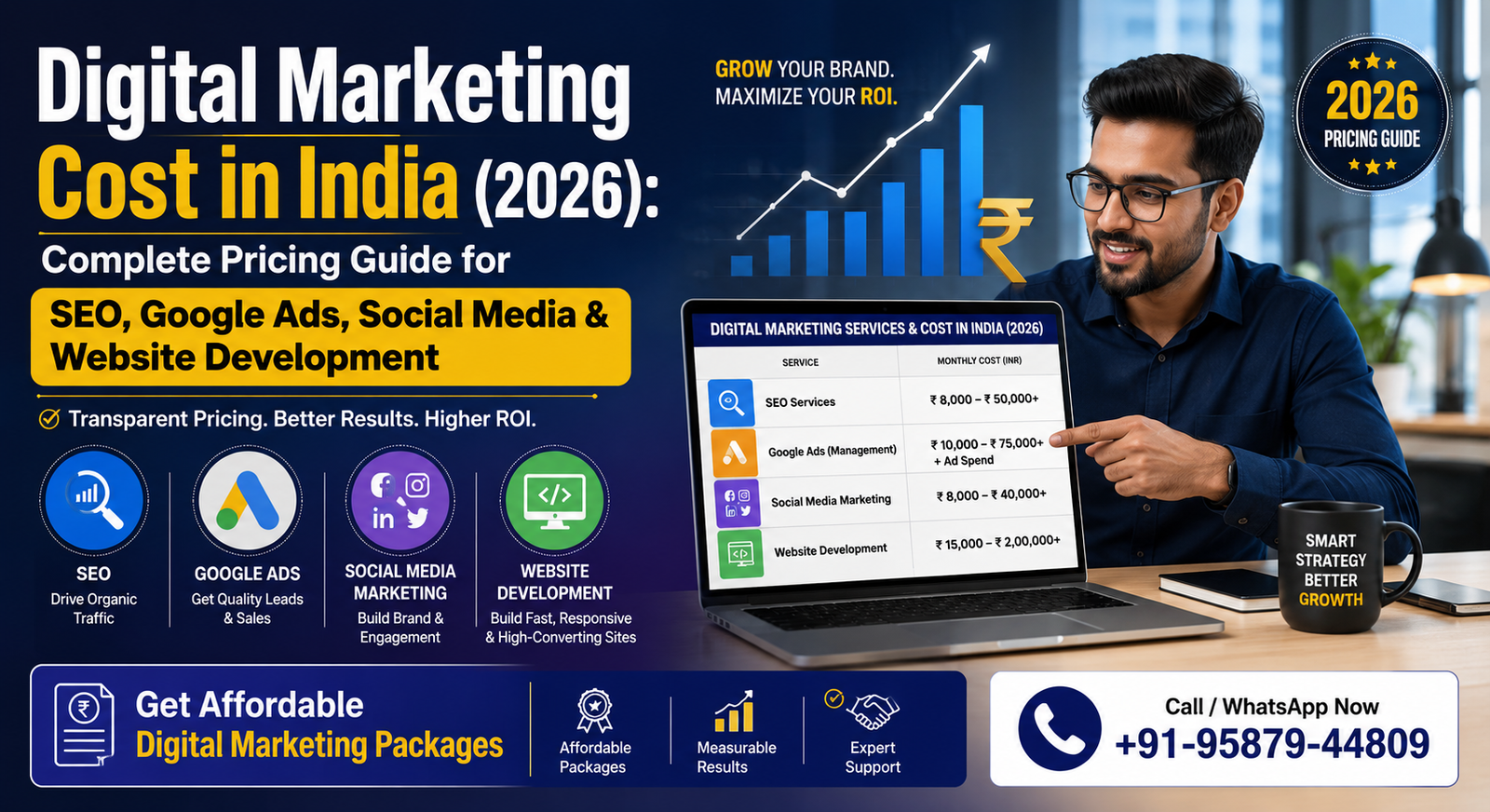
| Service | Price Range in Rupees |
| SEO | 10,000 to 1,00,000 per month |
| Google Ads Movement | 10,000 to 50,000+ ( per month ) |
| Social Media Marketing | 15,000 to 80,000 + ( per month) |
| Website Development | 20,000 to 2,00,000 ( per month) |
| ECommerce Website | 50,000 to 5,00,000+ ( per month ) |
Treat these as a starting sketch, not a rulebook. Your actual number depends on business size, how crowded your space is, and honestly, which agency you end up trusting with it.
SEO Pricing in India
SEO might be the single most misquoted line item in this whole industry — mostly because “SEO” means five different things depending on who’s saying it.
Local SEO is usually the cheapest entry point, and for good reason. If you’re running one location — a clinic, a salon, a small restaurant near Koregaon Park — local SEO pricing stays modest because the work is contained. Google Business Profile cleanup, a few location pages, citations, review management. You’re not fighting the whole internet, just your own pin code, basically.
Ecommerce SEO costs a lot more, and people are always surprised by how much. You’re not optimizing one homepage anymore — you’re optimizing hundreds of product pages, category pages, filters, and untangling the duplicate content mess that most ecommerce platforms create on their own.
Enterprise SEO sits at the very top. Big organizations need strategists, developers for the technical side, content teams all moving in parallel. It’s not really a retainer at that point — it’s basically an outsourced in-house team.
Technical SEO — site speed, crawl issues, schema, Core Web Vitals — gets billed separately more often than you’d think. If a quote never even mentions technical SEO, that’s worth asking about before you sign.
Content SEO is where budgets quietly creep up. Blog posts, service pages, pillar content — none of that writes itself, and decent content takes real research hours, not keyword-stuffed filler that Google’s gotten pretty good at ignoring anyway.
Google Ads Pricing
Google Ads management cost usually breaks into three separate pieces, and agencies that blur them together tend to make everything murkier than it needs to be.
First — the management fee. This is what you pay the agency itself: keyword research, ad copy, ongoing optimization. Most charge a flat monthly rate, or somewhere around 10–20% of your ad spend.
Second — your actual ad budget. This money goes straight to Google, not the agency, and it should always be a separate line item. If a proposal blends this in with the management fee, ask why.
Third — setup cost. Account structuring, conversion tracking, initial audience research. Some agencies waive it if you sign a longer contract; plenty of others charge it no matter what.
And don’t skip the landing page cost part. Sending paid traffic to a generic homepage is probably one of the most common ways businesses quietly waste their ad budget. A landing page built specifically for that one ad’s intent tends to convert noticeably better — we’ve seen it nearly double in some campaigns, which is not a small thing when every click costs money.
Social Media Marketing Pricing
Social media marketing cost comes down almost entirely to platform mix and how much content you actually want each month.
Instagram and Facebook usually get bundled since the content overlaps, though Instagram marketing cost has crept up a bit lately — reels take real editing time compared to a simple static carousel post.
LinkedIn costs more. The tone is different, more thought-leadership than lifestyle, and writing genuinely good LinkedIn copy isn’t something every social media handler is actually trained to do well.
YouTube sits at the top of this list. Scripting, filming, editing, thumbnails — all of it adds hours that a quick Instagram post never demanded.
Content creation and Reels deserve a specific callout, because packages quietly cap what’s included far more often than clients realize. A ₹20,000/month package might only include eight posts and two reels total. Always ask for the exact number before assuming “unlimited content” means what you think it means.
Website Development Cost
This category probably has the widest price spread of anything in this guide, and there’s a simple reason — a website can mean a five-page brochure site or a full custom platform running a thousand products.
A business website, maybe five to eight pages on WordPress, sits at the affordable end. It’s the right call for most service businesses that just need a clean, professional presence online.
An ecommerce website costs a lot more. Ecommerce website development cost includes payment gateway setup, inventory syncing, and often custom UX work that no template can really handle properly.
WordPress websites remain the go-to budget option for small businesses, mainly because the CMS itself is free and the plugin ecosystem around it is massive.
A custom website — coded from the ground up, no CMS — costs more upfront, but hands you total control over functionality. Makes sense if your requirements are specific enough that off-the-shelf platforms just won’t stretch that far.
A Shopify store lands somewhere in between. Costs more than WordPress, but launches faster than a fully custom ecommerce build, since the platform handles a good chunk of the backend work for you already.
Freelancer vs Agency Pricing
This debate comes up in almost every consultation, and there isn’t one right answer. Freelancers charge less because overhead is minimal — no office, no layered approvals, no account manager sitting between you and the actual work. For a business just starting out, that lower digital marketing agency cost genuinely makes sense.
But there’s a catch. One freelancer juggling five clients at once might not have the bandwidth to dig into a messy technical SEO problem or manage a Google Ads account running twenty campaigns simultaneously. Agencies like Digital Socialite bring more structure — dedicated specialists, proper reporting, someone to step in if your usual contact is unavailable.
Our honest take? If your needs are simple, a solid freelancer works fine. Once you’re juggling SEO, ads, and social media all at once, an agency’s overhead starts earning its keep just through coordination alone.
Industry-wise Digital Marketing Cost
Costs shift a fair bit by industry, and understanding why helps before you compare your own numbers to someone else’s.
Healthcare businesses often pay more, mostly because of compliance requirements and how careful the content needs to be around medical claims.
Education brands see costs spike around admission season specifically — heavier ad spend, more content, then it eases off for the rest of the year.
Real estate marketing leans hard into lead generation — paid ads and landing pages carry more weight here than organic content usually does.
Manufacturing companies, interestingly, need less flashy social media and more focus on technical SEO plus B2B lead generation cost strategies. LinkedIn matters far more here than Instagram ever will.
Hotels deal with seasonal swings, so ad budgets move up and down through the year more than a typical retail business would ever need to.
Restaurants benefit hugely from hyper-local SEO and geo-targeted social ads instead of broad national campaigns — nobody’s ordering biryani from three states over, after all.
Law firms pay a premium on content specifically, since legal writing needs an accuracy that a generalist content writer usually can’t deliver on their own.
Hidden Costs You Should Know
This section exists because too many businesses get blindsided by costs nobody mentioned during the pitch.
GST adds 18% on top of every invoice. Factor it in before comparing quotes — a number that excludes GST looks artificially cheaper than one that includes it upfront.
Premium tools like SEMrush, Ahrefs, or Canva Pro sometimes get billed separately, sometimes get folded into the retainer. Ask which.
Content writing often shows up as an add-on rather than something bundled into SEO packages, especially for blogs and longer-form pages.
Hosting and domain renewal are small annual costs on their own, but they stack up over a few years and get forgotten easily during budgeting.
Graphic design for social posts or ad creatives sometimes sits entirely outside the “management fee,” which surprises people more often than it should.
CRM integration and call tracking software come up more and more, particularly for lead-gen-heavy businesses, and both carry their own subscription costs on top of everything else.
How Much Should Startups Spend?
A reasonable startup marketing budget usually lands around 7–10% of projected revenue — though early-stage startups sometimes have to spend before revenue even exists, which makes that rule feel a bit theoretical at the moment.
Our advice, plainly: don’t spread a small budget across five channels at once. Pick one or two that are most likely to bring customers in fastest — usually Google Ads for quick visibility, or local SEO for service businesses — get those working first, then diversify once there’s actual data to lean on.
Digital Marketing Budget Calculator
We don’t have a live calculator embedded on this page, but the rough math most agencies use goes like this: take your monthly revenue target, set aside 10–15% for marketing, then split that across channels based on where your customers actually spend their time. A B2B manufacturing company might put 60% into LinkedIn and SEO. A D2C fashion brand would probably flip that entirely toward Instagram and Meta ads instead.
Which Package Is Right for Your Business?
Still unsure? It usually comes down to your main goal. Need local visibility? Our SEO services and local SEO guide can map that out properly. Running paid campaigns already? Our Google Ads services team builds packages around your budget and industry specifics. Need steady content and community management? Our social media marketing services cover that end. And if the website itself needs rebuilding, our website development services team can walk you through WordPress, Shopify, or a fully custom build — whatever actually fits.
Frequently Asked Questions (FAQs)
Q1. What is the average digital marketing cost for small businesses?
Ans.It was somewhere between ₹15,000 and ₹50,000 a month, depending on which services get combined.
Q2. Is SEO a one-time cost or ongoing?
Ans.Ongoing, always. SEO pricing India runs on a monthly retainer model because rankings need constant upkeep, not a one-time fix and forget.
Q3. How much should I budget for Google Ads as a beginner?
Ans.Start smaller — ₹15,000–₹20,000 in ad spend plus a management fee gives you enough data to see what’s actually working before scaling further.
Q4. Do agencies charge extra for content writing?
Ans.Quite often, yes. Always confirm whether content sits inside your SEO packages or gets billed as a separate line.
Q5. What’s cheaper — WordPress or Shopify?
Ans.WordPress website cost is generally lower upfront, though Shopify’s built-in ecommerce features can save real development time for online stores.
Q6. Why do ecommerce websites cost so much more than business websites?
Ans.Payment gateways, inventory management, product pages, custom UX — all of it adds hours a basic brochure site simply never needed.
Q7. Should I hire a freelancer or an agency?
Ans.Depends on complexity. Freelancers suit simple, single-channel needs. Agencies make more sense once you’re running multiple services together.
Q8. How much does local SEO cost compared to national SEO?
Ans.Local SEO pricing stays significantly lower since both the competition and the scope are narrower.
Q9. Are there hidden costs I should ask about upfront?
Ans.Yes — GST, premium tools, hosting, content writing, and graphic design are the ones people forget to ask about most often.
Q10. What’s a reasonable digital marketing budget for a startup?
Ans.Roughly 7–10% of projected revenue, focused on one or two high-impact channels to start.
Q11. Does social media marketing cost include content creation?
Ans.Not always. Check whether reels, design, and copywriting are actually included or billed as extras on top.
Q12. How much does a landing page cost separately from Google Ads management?
Ans.Varies with complexity, but a dedicated landing page is almost always worth it given the conversion lift it tends to bring.
Q13. Is it worth paying more for an enterprise SEO package?
Ans.For large, competitive industries — yes, generally. The scale of technical and content work justifies the higher SEO cost in India at that tier.
Q14. How often should I review my digital marketing agency cost against results?
Ans.Quarterly works well for most businesses — enough time to see real numbers, not so long that underperformance slips by unnoticed.
Q15. Can I negotiate digital marketing pricing India rates with agencies?
Ans.Often, yes — especially with longer contracts or when bundling SEO, ads, and social media together under one agreement.
Read Also:-Cost of Digital Marketing Training in Jaipur: A Quick Guide
Conclusion
Digital marketing agency cost in India was never going to be one fixed number. It shifts with your industry, your city, your goals, and honestly, which agency you choose to trust with it. The real win isn’t finding the cheapest quote in your inbox — it’s understanding exactly what that quote includes. Ask for a proper line-item breakdown, get the hidden costs out in the open early, and compare packages by scope, not just the number at the bottom. If you’d rather skip the guesswork entirely, Digital Socialite can walk you through a package built around your actual budget and goals — no vague bundling, just a straight breakdown you can compare against anyone else’s quote.