Ask ten SEOs what makes a website rank and most of them will mention backlinks before you’ve even finished the question. Fair enough — they matter. But somewhere along the way, a lot of businesses started treating backlinks like a scoreboard. More links, better ranking, done. It doesn’t really work like that, and it never fully did. Backlink Profile Analysis is less about the count and more about what your links are actually saying about you.
A link profile should be judged on relevance, authority, how the anchor text looks, and whether it grew the way a real, organic profile would. Pile up enough low-quality or spammy links and things can go sideways quietly — trust signals slip even without a formal penalty landing in your inbox. That’s the gap a proper backlink profile audit is meant to close. This guide walks through what a healthy profile looks like, where the warning signs usually hide, and how to start looking at your own site’s links a little more critically.
What Is a Backlink Profile?
Put simply, a backlink profile is every inbound link pointing to your site from other domains, taken as a whole. Not a list so much as a pattern — each link carries a bit of context about who’s linking, why, and how.
One backlink on its own doesn’t tell you much. It’s the full picture, hundreds or thousands of links together, that search engines actually lean on to judge how trustworthy and relevant a site is. Google isn’t reading links one at a time in a vacuum. It’s looking at where a link sits, what surrounds it, and how the linking site tends to behave overall.
What Does a Backlink Profile Include?
- Number of referring domains — how many unique websites link to you
- Total backlinks — the overall count, including multiple links from the same domain
- Linking domain quality — how trustworthy and established the linking sites are
- Link relevance — whether the linking content is topically related
- Anchor text — the clickable text used in each link
- Follow, nofollow, sponsored and UGC attributes
- Link placement — where the link sits on the page
- New vs lost backlinks over time
- Geographic and domain diversity
Why Is Backlink Profile Analysis Important for SEO?
A regular backlink analysis isn’t just something you do to feel thorough. It’s genuinely one of the more useful habits an SEO team can build into its routine — and the reasons for that are worth spelling out.
Identifies High-Quality Links
Not every link pulls the same weight. One mention from a respected, relevant publication can outweigh a dozen random links from pages that have nothing to do with your industry. Spotting which links are actually doing the heavy lifting tells you what’s working in your outreach or content efforts — and what isn’t worth repeating.
Finds Potentially Harmful Patterns
Every so often a profile has warning signs sitting right in it — links from clearly irrelevant sites, spam patterns that are hard to miss once you know what to look for, or link-building activity that reads as manipulated rather than earned. Catching these early means you’re dealing with a small problem instead of a bigger one down the line.
Helps Understand Competitor Link Strategies
There’s real value in seeing where competitors are picking up legitimate mentions. It tends to surface content gaps, publications worth pitching, or partnerships you might not have thought of otherwise.
Supports Long-Term SEO Decisions
This isn’t a once-and-done task. A backlink audit works best folded into ongoing SEO monitoring rather than treated as a box to tick and forget about. One caveat worth flagging: not every low-quality link automatically triggers a Google penalty. Context matters more than people give it credit for, and chasing down every weak link can burn time that would be better spent elsewhere.
What Does a Healthy Backlink Profile Look Like?
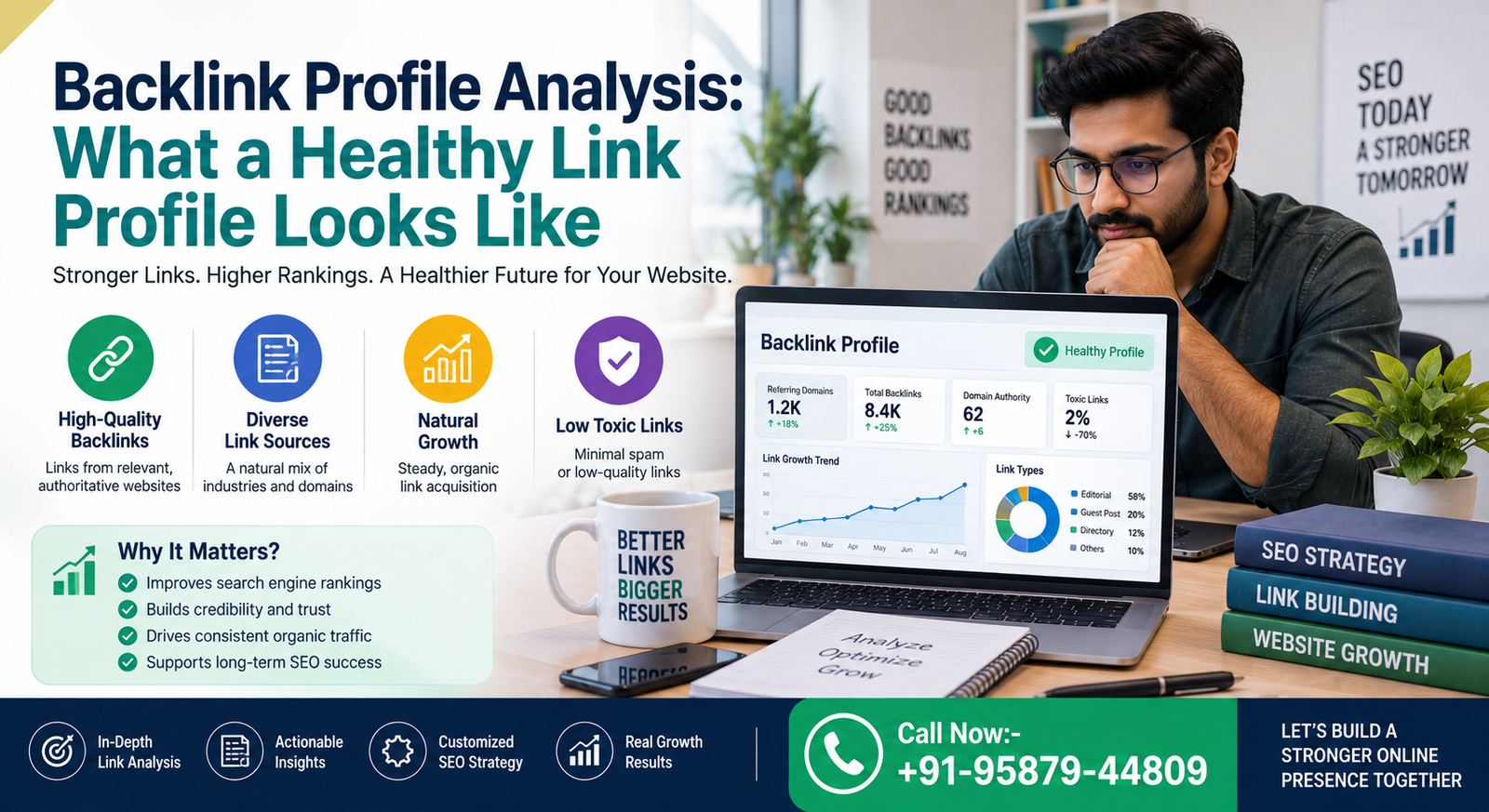
This is really the core of it. If you’ve been wondering what a healthy backlink profile is supposed to look like once you get past the theory, these are the signals that tend to show up.
Links Come From Relevant Websites
Relevance usually beats raw authority. A digital marketing company should be picking up links from marketing, business, tech, local-business or industry publications — not from some completely unrelated corner of the internet. A link from a site with zero connection to your field just doesn’t carry the same weight, no matter how big that site is.
Referring Domains Have Genuine Value
500 links from one weak, low-quality domain aren’t better than 20 links from sites that are actually useful and relevant. Honestly, they’re usually worse. A healthy profile leans toward variety and quality rather than bulk for the sake of bulk.
Anchor Text Looks Natural
A healthy profile tends to have a fairly natural spread of anchor text types — nobody’s engineering it. You’ll typically see:
- Brand anchors (the company name itself)
- Naked URLs
- Generic anchors — “click here,” “read more,” that sort of thing
- Partial-match anchors
- A smaller slice of relevant, descriptive anchors
What you don’t want is a suspiciously tidy ratio where someone deliberately pushed the exact-match anchor percentage up to try to game rankings. Real link building is messier than that — and honestly, the mess is a good sign, not a flaw.
Links Are Earned From Different Types of Websites
Diversity says a lot about how natural a profile is. Healthy profiles usually pull from a mix — industry sites, news and publications, blogs, general business resources, local sites, professional bodies, and the occasional relevant directory. If one type of source is doing all the heavy lifting, that’s usually worth a second look.
Link Growth Looks Reasonably Natural
A sudden, unexplained burst of backlinks is worth digging into — it can point to manipulative link-building. But not every spike is a red flag. A genuine PR win, a piece that goes a bit viral, or content that several publications pick up around the same time can create a perfectly legitimate spike. Context decides which is which.
Key Metrics to Check During Backlink Profile Analysis
When you actually sit down to run a link profile analysis, a handful of metrics matter more than the rest.
Referring Domains
The number and quality of unique linking domains tells you more than a raw backlink count ever will. Ten links from ten different reputable sites generally say more about your credibility than a hundred links coming from just two or three domains.
Domain and Page Relevance
A link on a page that’s genuinely relevant to your industry hands search engines far more meaningful context than a random link buried on some unrelated page.
Anchor Text Distribution
Look at whether the anchor text across your profile leans heavily branded, URL-based, generic, or commercially optimised. A hard skew in one direction — especially toward commercial exact-match terms — is worth a closer look.
Follow and Nofollow Links
There’s a persistent myth that nofollow links are worthless, or somehow automatically “bad.” They’re not. Real websites naturally use a mix of link attributes, and a profile that’s entirely dofollow can actually look less natural than one with some balance to it.
New and Lost Backlinks
Keep tabs on what’s newly acquired, what’s been lost, and — this one matters — any significant links lost from authoritative sites, since those tend to have an outsized effect either way.
Link Placement
A contextual, editorial link sitting naturally inside useful content is a different animal from one stuffed into a spammy comment thread or a sitewide footer. Where a link lives says a lot about how genuinely it was earned.
Healthy vs Unhealthy Backlink Profile
A side-by-side view usually makes the distinction click faster than any explanation:
| Healthy Profile | Unhealthy Profile |
|---|---|
| Relevant referring websites | Random unrelated websites |
| Natural anchor text | Excessive exact-match anchors |
| Editorial/contextual mentions | Manipulative paid links |
| Diverse referring domains | Heavy dependence on a few domains |
| Gradual, natural acquisition | Suspicious automated link bursts |
| Useful content-based links | Spam comments |
| Genuine business/brand mentions | Low-quality link networks |
Worth repeating: these are signals to look into, not automatic proof that a site has been penalised. Google has specifically called out things like buying or selling links for ranking purposes, excessive link exchanges, automated link creation, and low-quality directory or bookmark links as examples of link spam. But a single questionable link, on its own, rarely tells the whole story.
Common Types of Bad or Risky Backlinks
A handful of link types keep showing up whenever something’s gone wrong in a profile.
Paid Links Designed to Manipulate Rankings
There’s a real line between legitimate advertising or sponsorship and links that exist purely to pass ranking credit. The first is just business. The second runs against search engine guidelines.
Excessive Link Exchanges
“You link to me, I’ll link to you” isn’t automatically a problem. It becomes one when the whole point is manipulating rankings rather than actually connecting relevant resources.
Automated Backlinks
Links pushed out through automated programs or mass link-building software tend to leave fairly obvious footprints, and they rarely survive close scrutiny.
Spammy Blog Comments
A link dropped into an irrelevant blog’s comment section adds almost nothing, and more often than not it does more harm to your credibility than good for your rankings.
Low-Quality Directories and Bookmark Sites
Not every directory deserves suspicion — plenty are perfectly legitimate. The problem shows up when low-quality directories become a shortcut for manipulating rankings rather than an actual business listing.
Private Link Networks
These are groups of sites built mainly to pass links between each other for ranking purposes. Google calls out several variations of this under its link-spam policies, and they’re generally best avoided entirely.
How to Perform a Backlink Profile Analysis Step by Step
If this is your first pass at it, here’s a practical way to work through a backlink profile audit:
Step 1 — Export Your Backlinks
Pull your full link data from a reputable SEO or backlink analysis platform.
Step 2 — Review Referring Domains
Look closely at how good, how relevant, and how varied the linking domains actually are.
Step 3 — Analyze Anchor Text
Scan for anything unnatural, especially a heavy lean toward commercial exact-match anchors.
Step 4 — Review the Linking Pages
Open a sample of your important backlinks and see whether they genuinely sit within useful, relevant content, or just got tacked on somewhere.
Step 5 — Identify Suspicious Patterns
Watch for irrelevant websites, oddly large link clusters, pages that look automated, sitewide links, foreign-language spam that has nothing to do with your niche, and anchors stuffed with keywords.
Step 6 — Compare With Competitors
See where competitors are picking up legitimate links and which content formats seem to be pulling weight for them.
Step 7 — Document Findings
Sort everything into simple buckets — Keep, Monitor, Investigate, or Potentially Remove/Disavow — so the next steps are obvious rather than a guessing game.
How to Improve an Unhealthy Backlink Profile
Stop Manipulative Link Building
If a current strategy is built mainly around manipulating rankings rather than earning genuine mentions, that’s the first thing that needs to stop.
Focus on Earning Relevant Links
Mostly this comes down to making things worth linking to — original research, genuinely useful guides, real statistics, case studies, expert contributions, digital PR, and content that other sites would want to reference on its own merit.
Contact Website Owners When Appropriate
For links that were clearly intentional and can reasonably be taken down, reaching out to the site owner directly is sometimes worth trying.
Use Google’s Disavow Tool Carefully
The disavow tool was never meant to be a routine cleanup for every weak backlink you happen to notice. Save it for genuinely serious situations — a substantial unnatural-link problem that can’t be resolved any other way. There’s no need to disavow every low-authority link, or every link that scores badly on some third-party “toxicity” scale.
Backlink Profile Analysis Tools
A handful of tools keep coming up among SEO professionals doing this kind of work:
Google Search Console
Good for seeing exactly which links Google itself is reporting for your site.
Ahrefs
Commonly used for backlink discovery, referring-domain data, and anchor-text analysis.
Semrush
Useful for backlink audits and for building a clearer picture of what competitors are doing link-wise.
Moz Link Explorer
Another solid option for backlink and domain-level research alongside the tools above.
One thing worth keeping in mind — the “toxicity” or authority scores these tools spit out are proprietary metrics belonging to that tool, not a direct readout of a Google penalty. They’re useful for flagging things worth a second look, but they’re not gospel.
How Often Should You Analyze Your Backlink Profile?
A newer site usually gets by with periodic monitoring while its link profile is still small. Established sites tend to do better with a monthly or quarterly review, depending on how much link activity is going on. After a major SEO campaign, it’s worth an extra check. Noticed some suspicious backlink growth? Look into it promptly rather than letting it sit. And if a ranking drop or manual-action concern ever comes up, that’s the moment for a proper, deeper audit.
Backlink Profile Analysis Checklist
A quick, practical checklist to run through:
☐ Check referring domains
☐ Review link relevance
☐ Analyze anchor text
☐ Check important linking pages
☐ Review follow/nofollow attributes
☐ Identify suspicious patterns
☐ Check new and lost backlinks
☐ Compare competitors
☐ Document potentially problematic links
☐ Focus future link building on relevant, valuable content
Read Also:–How to generate high-quality backlinks for SEO services in Delhi
FAQs About Backlink Profile Analysis
Q.1What is backlink profile analysis?
Ans.It’s the process of going through every inbound link pointing to a site — where it’s from, how relevant it is, what the anchor text says, how the profile grew — to get a read on the overall health of that link collection, not just its size.
Q.2What does a healthy backlink profile look like?
Ans.Broadly: relevant sources, natural anchor text spread, a genuinely diverse set of referring domains, and editorial links earned through content or real relationships rather than engineered.
Q.3Are all low-authority backlinks harmful?
Ans.No. Low authority by itself doesn’t make a backlink harmful. Plenty of small, perfectly relevant websites carry modest authority scores while still adding genuinely useful context.
Q.4How many backlinks should a website have?
Ans.There’s no magic number. It depends on your industry, your competition, and your content. Quality and relevance matter a lot more than hitting some arbitrary count.
Q.5Are nofollow links bad for SEO?
Ans.No — nofollow is just a link attribute. A natural profile usually has a mix of both follow and nofollow links anyway.
Q.6Should I remove every toxic backlink?
Ans.Not necessarily. Third-party toxicity scores are useful as a signal, but they’re not automatic proof that a link is genuinely hurting your site.
Q.7How can I build a healthy backlink profile?
Ans.Lean into useful, original content, real digital PR effort, genuine relationships within your industry, and links that are earned editorially rather than manufactured.
Final Thoughts
A healthy backlink profile was never really about racking up the biggest possible number. It’s about building a natural collection of relevant, useful, credible references from across the web — the kind that would exist whether or not you were actively trying to rank for anything at all.
For businesses that want to get this right, the focus has to stay on quality, relevance, natural acquisition, and genuine value to users — not shortcuts that might work for a while but rarely hold up under scrutiny. If you’re looking for a hand reviewing your current link profile, or want a more sustainable SEO strategy built around it, The Digital Socialite works with businesses on exactly this kind of long-term, quality-first approach to SEO and backlink strategy.