Search doesn’t work the way it used to. A few years back you’d type in a question, scroll past ten blue links, and click around till you found something useful. These days? Half the time the answer just sits right there on the screen. No clicking needed. That’s the world Google AI Overviews, ChatGPT, Bing Copilot, and Perplexity have quietly built, and honestly, it’s changing how businesses have to think about being visible online.
This is where Answer Engine Optimization comes into play. AEO is more than simply chasing rankings, it is about making sure your content is actually picked up, understood and quoted by the artificial intelligence systems people ask instead of just “Googling it.” In this guide we’ll explore what it really means, how it is different from traditional SEO and what businesses need to start doing to stay visible as search continues to head toward AI.
What is Answer Engine Optimization (AEO)?
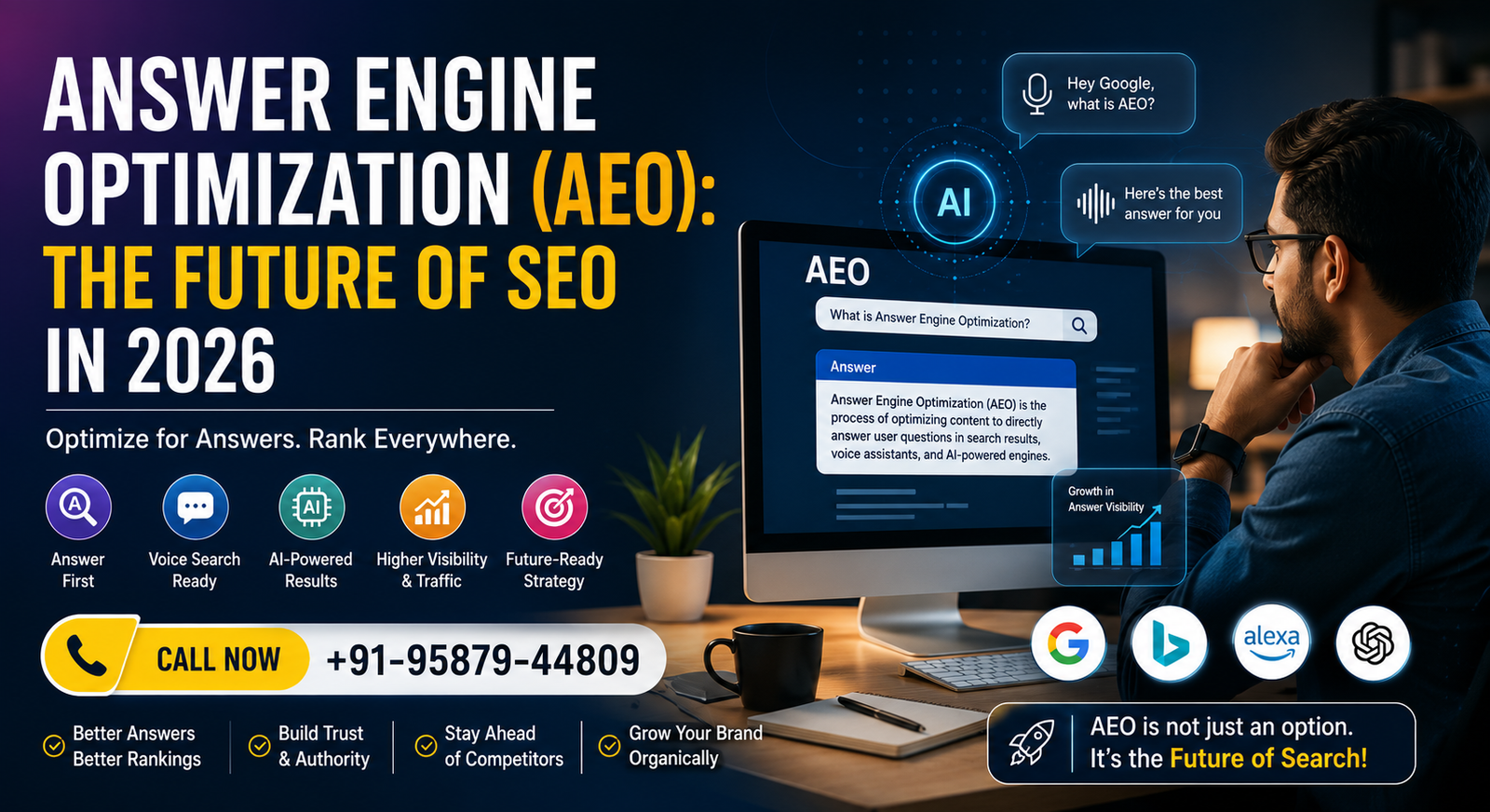
In plain terms, it’s the practice of structuring and writing content so AI-powered platforms can pull it out, understand it, and present it as a direct answer. The goal isn’t a ranking position anymore. It’s being the source an answer engine actually reaches for.
Answer engines work a bit differently than the search engines we grew up with. Rather than crawling the web and handing back a ranked list of pages, they take a query, pull relevant bits from multiple sources, and stitch together one consolidated response — sometimes with a citation attached, sometimes not. ChatGPT, Gemini, and Google’s AI Overviews all work this way.
So what is the difference between a search engine and an answer engine? With a search engine, you have options. An answer engine provides you with a conclusion. And that difference matters a lot going into 2026, because people are clicking through ten results less and less when they already have something that looks like a solid answer in front of them. Your content won’t be pulled in if it’s not written in a “answer-ready” style, no matter how well it happens to rank in the old sense.
How Answer Engines Work
To see why any of this matters, it helps to know what’s happening behind the scenes. Google AI Overviews scan through indexed content and stitch together a summary pulled from several pages at once. ChatGPT and Gemini lean more on their trained knowledge, plus, more and more these days, live web browsing when they need something current. Bing Copilot blends search results with conversational generation, and Perplexity AI has built its whole identity around sourcing and citing answers transparently — which, credit where it’s due, is a genuinely useful habit for an AI tool to have.
Voice assistants throw in another layer entirely. Ask your phone “what’s the best digital marketing agency near me” and there’s no scrolling involved at all — it just reads out one answer, maybe two if you’re lucky. That’s a zero-click answer playing out in real time: the question gets resolved and the person never even opens a browser tab.
Underneath all of it is roughly the same three-step process. Gather content from across the web, weigh it for relevance and trustworthiness, then present something synthesized back to the user. Content that’s well organized, accurate, and easy to skim through has a much better shot at being the one an AI system decides to surface.
Answer Engine Optimization vs Traditional SEO
It’s tempting to think of AEO as just “the new SEO.” That’s not quite right though. The two are chasing different goals, even if they overlap along the way.
| SEO | AEO |
| Focuses on rankings | Focuses on answers |
| Website clicks | AI visibility |
| Keywords | User intent |
| SERPs | AI-generated responses |
| Blue links | Featured answers |
| Organic traffic | Brand mentions & authority |
Traditional SEO is still, at its core, about climbing the results page and earning the click. This newer approach cares a lot less about where you sit in a ranking and a lot more about whether an AI system trusts your content enough to lean on it — even when that means the user never technically lands on your site at all.
But here’s the thing: these aren’t rival approaches. They’re complementary, and treating them like a competition misses the point entirely. Strong technical SEO — fast load times, clean site structure, solid backlinks — still builds the authority AI systems rely on when they’re deciding which sources to trust. Businesses that stack AEO on top of good SEO, rather than swapping one out for the other, are the ones actually set up for the long haul.
Why AEO is the Future of SEO
A few trends make it pretty clear this isn’t a passing fad. AI search adoption has climbed fast. Millions of people now open ChatGPT, Gemini, or an AI Overview as their first stop for a question, not their last resort after Google fails them. Voice search keeps climbing too, particularly among folks who’d honestly rather just ask a smart speaker than sit and type on their phone.
Google’s own AI Overviews now show up on a huge share of searches, usually parked right above the traditional results. That alone has quietly changed how far down the page most people even bother scrolling anymore. Add in zero-click searches becoming the default for anything simple or factual, and you’ve got a real problem for businesses that are still optimizing only for the click.
There’s a genuine user-experience side to this too, and it’s worth sitting with for a second. People like getting a straight answer. Nobody actually enjoys digging through five tabs for something that could’ve been answered in one sentence. AI assistants keep getting sharper at personalizing those answers based on context and past behavior, and as that conversational style of search keeps growing, AEO stops being a “nice to have” and starts being close to table stakes — right alongside the broader AI search optimization work most businesses are already putting money into.
Key Elements of a Successful AEO Strategy
Building a real strategy here involves a handful of moving pieces. Skip any one of them and it tends to show up pretty quickly in how AI systems treat your content.
Create Helpful Content
This sounds obvious, but it trips up a surprising number of sites. Answer engines favor content that genuinely helps the reader, not content written purely to chase a ranking. If it doesn’t answer a real question clearly, it’s not getting picked up — full stop.
Answer Real Questions
Build your content around the actual questions people are typing (or speaking) into a search bar, not just keyword variations that sound close enough.
Use Structured Data
Schema markup gives AI systems a much clearer picture of what your content is about, which makes it easier to extract and quote.
Improve EEAT
Experience, Expertise, Authoritativeness, and Trust. Still the backbone of all this. AI models are understandably cautious about leaning on sources that can’t demonstrate real credibility.
Optimize for Featured Snippets
Content that’s already formatted to win a featured snippet tends to slide right into AI-generated answers too, since both favor short, direct responses over long-winded ones.
Add FAQ Sections
FAQs mirror how people naturally phrase questions to AI tools, which makes them one of the easier wins on this whole list.
Improve Website Speed
A slow site isn’t just a bad look for users — it can quietly affect how reliably crawlers get in and index your content at all.
Build Brand Authority
Mentions across other reputable sites and platforms add weight to how AI systems judge your credibility as a source.
Keep Content Updated
Simple but often ignored: answer engines lean toward fresh, accurate information over pages that haven’t been touched in years.
Use Conversational Language
Much of this traffic is now coming from voice search and chat like interfaces, and a natural, conversational tone just fits how people actually ask things out loud.
Best Practices for Optimizing Content for AI Search Engines
In addition to your core strategy, there are some easy habits that can make content far more “AI friendly,” and none require you to re-invent your whole content process.Question as a heading mimics the way people ask questions, so it is immediately obvious what each section is going to answer. Combine this with a short , direct answer at the start of the section and allow the details to emerge below.
I do like a bulleted list.Tables are good too, really. They are simple for AI models to extract. Real stats to back up claims give you credibility and author bios go a long way to show actual expertise , especially with every new EEAT update raising the bar.
Internal linking helps users find related content on your site , and linking out to reputable external sources proves you’re not just talking to yourself in an echo chamber. On the technical side , semantic SEO and entity optimization help both search engines and AI SEO services understand how the topic, people and concepts on your page actually related to each other , not just what keywords they happen to contain.
Common AEO Mistakes to Avoid
Even businesses that understand the theory trip up when it comes to execution. Keyword stuffing is probably the most common offender — cramming phrases unnaturally does more harm than good, and AI systems are genuinely good at spotting forced, awkward language now.
Thin content is another repeat offender. A page that barely scratches the surface of a topic just isn’t going to earn enough trust to get quoted. Same goes for ignoring user intent: writing what you want to say instead of what people are actually asking tends to backfire, every time.
Skip structured data and you’re leaving AI systems to guess at your content’s shape. A clunky, slow website experience turns away both users and crawlers alike. Outdated information is a quieter problem, but it adds up, since answer engines steadily deprioritize stale pages. And without visible credibility markers, even solid, accurate content can lose out to a source that simply looks more trustworthy on the surface.
AEO Tools Every Marketer Should Know
There are a few tools that make tracking all this a lot less painful. Google Search Console will tell you exactly how your pages are performing in search – which queries are pulling in AI Overviews – and Google Analytics 4 will fill in the picture by tracking how visitors actually behave once they land.
ChatGPT and Google Gemini are worth using yourself, just to check how your brand currently shows up in AI-generated answers — it’s oddly revealing. Bing Webmaster Tools covers similar ground for Microsoft’s ecosystem, and Perplexity AI is worth keeping an eye on for how openly it cites its sources.
On the more technical side, a Schema Markup Validator confirms your structured data is actually implemented correctly. Semrush and Ahrefs are still the go-tos for keyword research and competitive digging, and Screaming Frog remains solid for auditing a site’s overall technical health.
Benefits of Answer Engine Optimization for Businesses
The return on investment here is much more than a traffic number on a dashboard.Brands that keep showing up in AI-generated answers get a lot more visibility,often in front of people who would never have scrolled down far enough to find them the old-fashioned way.
That visibility builds trust over time, and there’s something to be said for the fact that getting cited by an AI assistant carries its own kind of implicit credibility. It also tends to boost authority within an industry, since AI systems generally lean toward sources that other reputable sites already reference.In business terms, this generally translates to better lead generation and a far better user experience, simply because people are receiving relevant answers faster.
The businesses that adapt early will have a significant long-term advantage over those that continue to rely on traditional rankings alone. And it’s better to prepare for AI search now than to scramble to catch up once the rest of the world has.
Why Businesses Should Invest in AEO in 2026
The reality is that search behaviour has really changed into an AI-first mindset. People ask a question and expect an immediate, synthesized answer,not a list of ten things to sort through themselves. That means relying on traditional rankings alone is no longer a risk many businesses can afford to take.
Getting featured in an AI-generated answer puts a business directly in front of someone at the exact moment they’re looking for a solution, which naturally opens up better conversion opportunities. And since most competitors are still catching up to what this even means in practice, businesses that get moving now have a real window to get ahead before it becomes standard practice across every industry.
Why Choose The Digital Socialite for AEO Services?
If you’re running a business out of Jaipur, or really anywhere else in India, and you’d rather actually implement all of this than just read about it, that’s where The Digital Socialite comes in. We don’t choose AI over traditional SEO, we bring the best of both worlds to you. Our team has expertise in AI Search Optimization as well as a strong background in traditional SEO.
We work on content optimization from the ground up, including structured data implementation, so that your pages are really easy for artificial intelligence systems to parse. All the things we build are EEAT-focused content, backed up with technical SEO fundamentals to keep your site fast, clean and crawlable, as well as AI-friendly website optimization and ongoing performance tracking, so you’re never guessing what’s actually working.
Every business has different needs, which is why we create custom digital marketing solutions rather than cookie-cutter packages. If you want to know how your brand is doing at present, get in touch with The Digital Socialite for an AI search optimisation audit and consultation.
Read Also:-SEO Vs. AEO Explained: Which One Matters Most
Frequently Asked Questions (FAQ)
Q1. What is Answer Engine Optimization?
Ans.It’s the practice of making changes to the content so AI platforms like ChatGPT, Google AI Overviews and Bing Copilot can snatch it and present it as a direct answer, instead of just another link in a sea of results.
Q2. What is AEO and how is it different from SEO?
Ans.Traditional SEO chases rankings. This approach chases something a bit different — becoming the source an AI system actually chooses to quote, whether or not you’re sitting in the top spot.
Q3. Does Google AI Overview affect SEO?
Ans.Yes and it’s happening already. Overview snippets are stealing clicks from traditional listings, so businesses should optimize specifically to be featured inside those summaries, not just rank below them.
Q4. Can AEO improve website traffic?
Ans.It can, mainly through qualified visitors clicking through after seeing a brand mentioned in an AI answer. That said, a good chunk of the real value here is brand visibility, not direct clicks.
Q5. Is AEO important for small businesses?
Ans.Honestly, yes — maybe more than people expect. AI systems tend to prioritize clear, trustworthy content over sheer domain size, which levels the field more than traditional rankings ever did.
Q6. How do I optimize content for ChatGPT?
Ans.Focus on clear, well-structured answers to specific questions. Back up claims with credible information, and keep everything updated and easy to scan.
Q7. What are the best AEO tools?
Ans.Google Search Console, Semrush, Ahrefs, Screaming Frog, and a Schema Markup Validator cover most of what you need to build and track an effective strategy.
Q8. Does schema markup help AEO?
Ans.It does. Structured data makes it far easier for AI systems to understand your content’s context and pull accurate information from it.
Q9. What is the difference between AEO and GEO?
Ans.AEO is centered on being featured in direct-answer formats. Generative Engine Optimization (GEO) is the broader umbrella term for optimizing content across generative AI platforms in general.
Q10. Is Answer Engine Optimization the future of digital marketing?
Ans.It’s shaping up that way. As AI search adoption keeps climbing, it’s becoming a core part of any serious digital marketing strategy — not an optional add-on anymore.
Conclusion
Answer Engine Optimization is reshaping how people find information online, and that shift shows no sign of slowing down. Businesses that adapt now, by optimizing for AI-generated answers instead of chasing rankings alone, are going to be in a far stronger position once this becomes simply how search works.
The smartest move isn’t picking a side between SEO and AEO. It’s combining them. Traditional SEO still lays down the authority and technical foundation a site needs, while this newer discipline makes sure that authority actually gets recognized by Google AI Overviews, ChatGPT, and every other answer engine shaping search in 2026 and beyond.