“SEO or PPC — which one first?” Wrong question. Every business owner circles back to it, and every time an agency answers “both,” it sounds like a dodge. It isn’t. [SEO] and [PPC] were never competing for the same seat at the table. Rank organically and you’ve earned your spot; run ads and you’ve rented it. PPC gets clicks the same afternoon you switch it on. SEO is the slower bet still paying off long after you’ve stopped thinking about it. What follows: how each one works, where the two overlap more than most businesses realize, and what running both actually looks like.
Understanding SEO and PPC
What Is SEO (Search Engine Optimization)?
Search Engine Optimization, stripped of the jargon, is just getting a website to rank higher in Google’s free results — no ad spend involved. Type a query, Google sorts through millions of pages, and hands the top spots to whichever sites look most relevant, most trustworthy, and technically sound. Worth the effort? Almost always — organic search still accounts for the bulk of traffic in most industries, and unlike ads, it doesn’t switch off the moment you stop paying. It compounds instead. Four pieces hold it up: on-page SEO (content, keywords, internal links), off-page SEO (backlinks you don’t fully control), technical SEO (speed, crawlability, mobile behavior), and local SEO (showing up for “near me” searches).
What Is PPC (Pay-Per-Click Advertising)?
PPC flips that model entirely. Nobody earns a ranking here — you’re bidding on it, through [Google Ads] or Bing Ads, and paying for every click that lands. And the biggest bid doesn’t automatically win the spot. Three things settle it: CPC, what you actually pay per click; Quality Score, built from relevance, expected click-through rate, and landing page quality; and Ad Rank, your bid weighted by how much Google trusts the experience you’ll deliver. Sharpen the [landing page] and cost per click tends to fall on its own. What PPC has that SEO can’t match is speed: switch it on this morning, see clicks by lunch.
SEO vs PPC – What’s the Difference?
| Feature | SEO | PPC |
| Cost | No per-click cost, ongoing content work instead | Pay per click, stops when spend does |
| Time to Results | Weeks to months | Same day |
| Traffic Source | Organic search | Paid ads, search and display |
| ROI | Compounds, cheaper per lead eventually | Solid, but needs continuous spend |
| Sustainability | Sticks around after the work | Gone once budget’s gone |
| Trust Factor | Higher by default | Lower, narrows with strong copy |
| Lead Generation | Slower start, better intent | Fast, scalable |
| Best For | Long-term authority | Quick wins, launches, promos |
| Scalability | Slower, capped by competition | Scales with budget |
Nobody wins this outright. One’s a long game you fund now and cash in later; the other’s the lever for when later isn’t an option.
Why Digital Marketing Agencies Use SEO and PPC Together
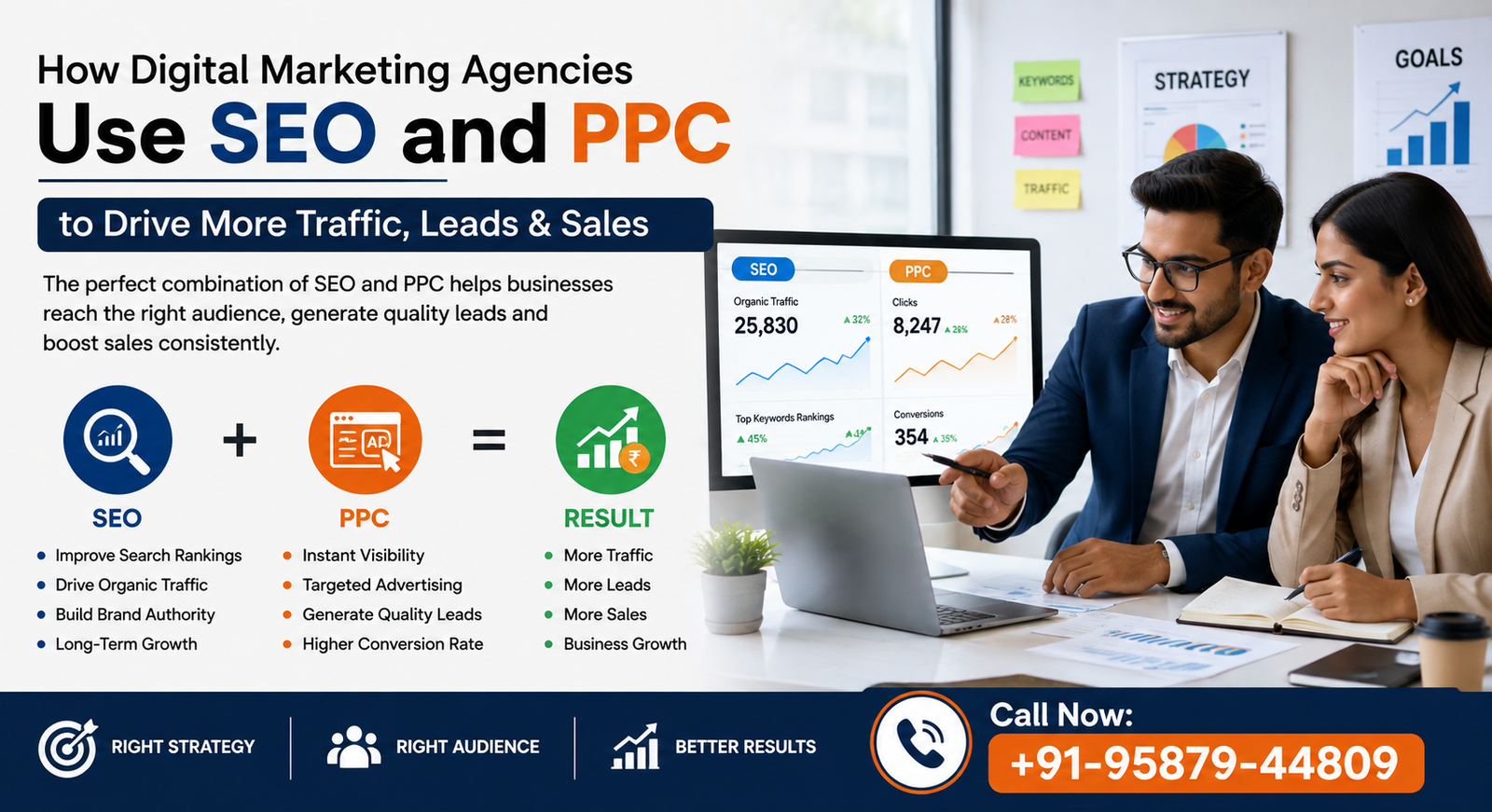
Run enough campaigns and most agencies stop betting the whole budget on one channel fairly quickly. PPC brings short-term wins, sometimes within hours. SEO builds the growth that keeps a business visible without an ad budget running forever underneath it. Put both to work and brand visibility climbs, since showing up in paid and organic results at once reinforces trust neither manages alone. Search presence widens, traffic quality improves as intent gets caught at more points along the buyer’s path, and there’s a competitive edge that’s hard to fake — a business showing up everywhere a rival shows up once just looks more established, whether the budget backs that up yet or not.
How SEO Supports PPC Campaigns
It’s almost a side effect, honestly. Do the SEO work properly and your landing pages just end up better — faster, more useful, the kind of thing Quality Score rewards without you aiming for it. The keyword research doesn’t stay locked in its own lane either; commercial-intent terms SEO turns up are exactly what a rushed PPC setup would’ve missed. Pages that are already SEO-solid tend to score higher on Quality Score too, which brings cost per click down more than people expect. And there’s trust underneath it all — someone who’s already read a helpful blog post converts more readily once they click that brand’s paid ad later.
How PPC Supports SEO Efforts
PPC keeps traffic flowing while SEO rankings climb in the background — useful for a new site with zero organic authority yet. It throws off fast data on which keywords convert, real signal for shaping SEO content instead of guessing. Showing up in both paid and organic listings for one term reinforces credibility, since people trust a name they’ve seen twice on a results page. And PPC platforms hand over demographic data that sharpens SEO targeting in ways organic data alone doesn’t.
Step-by-Step Process Digital Marketing Agencies Follow
Business analysis comes first — competitor research, audience understanding, mapping how they actually buy. Keyword research follows: commercial, informational, local, long-tail. Then SEO implementation — technical fixes, content, on-page work, link building, added gradually. Alongside it, PPC setup: objectives, ad groups, targeting, ad copy, landing pages, budget. Then ongoing optimization — traffic, CTR, conversion rate, cost per lead, ROAS, rankings — fixing whatever’s underperforming.
Benefits of Combining SEO and PPC
Faster leads from PPC, sustainable growth from SEO. Better ROI overall since each channel covers what the other’s weak at. Sharper customer targeting, more trust from dual visibility, wider search real estate claimed, and more data-driven decisions since each channel feeds insight the other can use. Remarketing gets stronger too — SEO-built audiences tend to convert better through PPC than cold traffic ever does.
Common Mistakes Businesses Make
Betting on only one channel is the big one, but hardly the only one. Skipping landing page work wastes ad spend before it has a shot at converting. Sloppy keyword targeting burns budget on searches that were never going anywhere. Skip conversion tracking and decisions get made on gut feeling. Skip A/B testing and real gains sit unclaimed. Let content go stale and SEO momentum stalls. And there’s the expectations mismatch — wanting SEO to move at PPC’s pace, or PPC to build SEO-style value — which makes a fine campaign look like a failure for no real reason.
Real-World Example
Example Business: Local Home Interior Brand
Walked in with almost no digital footprint, relying entirely on referrals. The agency built SEO blog content around design and renovation searches while running Google Ads for ready-to-buy keywords, rebuilding landing pages around each campaign. Six months later, organic traffic had grown substantially, leads were steadier, and acquisition cost had dropped as SEO content picked up the load PPC carried alone at the start. Pretty typical shape — PPC does the early lifting, SEO takes over as it matures.
How AI Is Transforming SEO and PPC
Keyword research used to be a slog — hours of manual digging. Now it’s minutes. Bidding’s gone mostly automated, adjusting itself in real time based on click likelihood, and it’s honestly beating manual bid management more often than agencies admit. Predictive tools give a decent read on what’s likely to work before real budget gets committed, saving a lot of expensive guessing. AI drafts content faster than any human could, though it still needs a real editor — skip that and quality drops fast. Targeting’s sharper for it too, and a lot of lead qualification that used to eat an afternoon now runs through chatbots instead.
How to Choose the Right Digital Marketing Agency
Look for SEO expertise backed by real results, not a slide claiming it. Google Ads certifications proving the team knows the platform. Transparent reporting, not a wall of jargon. Case studies with numbers you can check. Real experience in your industry. A customized strategy, not a reused template. A conversion-focused approach over vanity metrics. Ongoing optimization, not set-it-and-forget-it. And genuinely strong communication — a great strategy explained badly feels exactly like a bad one from the client’s side.
Why Choose Digital Socialite for SEO and PPC Services?
There’s no shortage of agencies claiming they do SEO and PPC well. What sets Digital Socialite apart is fairly simple: SEO specialists who’ve genuinely done the work, Google Ads professionals certified rather than self-declared, and strategy built around what your business specifically needs instead of a package sold to everyone else too. Decisions get made off real data, not hunches. Campaigns stay tied to ROI, not vanity numbers that look nice on a slide. Reporting is written so clients actually understand it. And there’s an actual person managing your account — not whoever’s free that week — with strategy shaped for your industry and optimization that keeps going well after launch.
Ready to build a strategy that actually works for your business? Get in touch with Digital Socialite for a personalized SEO and PPC strategy built around your goals.
Frequently Asked Questions (FAQs)
Q1. Is SEO better than PPC?
Ans.Not a fair comparison, really — SEO builds long-term traffic, PPC delivers immediate leads.
Q2. Can SEO and PPC work together?
Ans.Yes, and they tend to perform better together than either does alone.
Q3. Which delivers faster results?
Ans.PPC, easily. Leads can show up within hours; SEO takes weeks or months.
Q4. How much should I invest in SEO and PPC?
Ans.Depends on industry and goals — a balanced split to start, adjusted as data comes in.
Q5. How long does SEO take to show results?
Ans.Roughly three to six months for anything noticeable, longer in crowded industries.
Q6. Is Google Ads worth it for small businesses?
Ans.Often, especially when leads are needed now and organic growth can’t move fast enough.
Q7. How do agencies measure SEO and PPC success?
Ans.Organic traffic, keyword rankings, CTR, conversion rate, cost per lead, ROAS — tracked continuously.
Q8. Can PPC improve SEO rankings?
Ans.Not directly — Google doesn’t factor ad spend into organic results — but PPC data can sharpen SEO strategy.
Q9. What industries benefit most from SEO and PPC?
Ans.Most do, though real estate, healthcare, home services, and e-commerce tend to see the strongest returns.
Q10. Why hire a digital marketing agency for SEO and PPC?
Ans.Because doing both properly takes expertise, tools, and time most businesses don’t have sitting around in-house.
Conclusion
SEO and PPC were never really rivals. They work best as two halves of one strategy — SEO building lasting visibility that keeps paying off long after the work’s done, PPC delivering the immediate traffic that keeps things moving while that value builds. Treating them as opposing channels instead of complementary ones is a quiet, common way businesses leave growth sitting on the table. If you’re ready to stop picking sides, partner with Digital Socialite for a strategy shaped around measurable, sustainable growth.